

The Body Is a System You Don’t Fully Control
On peeling back the layers, the onion metaphor, and why systems literacy might be the most personal survival skill you’ll ever develop.

I’ve eaten Taco Bell and Whoppers.
I’ve eaten whatever was cheap, filling, and available.
Not because I didn’t care about health. Because I was a student, ignorant, and survival came before optimization.
This isn’t a confession. It’s context.
And it’s why I refuse to join the ingredient debate.
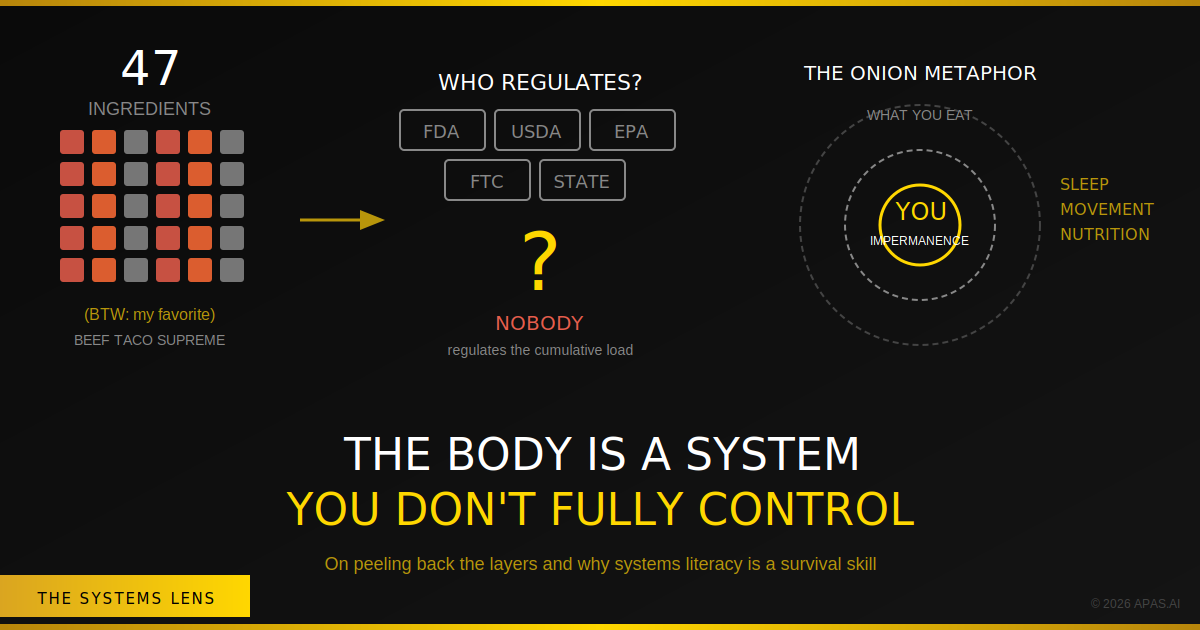
I’m not interested in whether 47 ingredients in the Beef Taco Supreme (BTW: my favorite) are legal. That conversation goes nowhere.
The question that matters is harder.
Why did our food system evolve to need this level of engineering?
The System That Feeds You
Nobody wakes up wanting additives. They wake up needing food that fits their life. I did.
Processed food isn’t a conspiracy. It’s an engineering response to broken constraints.
Shelf life.
National distribution.
Cost control.
Franchise scale.
You can’t build a national fast-food system without stabilizers and preservatives. That’s not ideology. That’s physics.
We engineered food to survive the system we built, not the humans who eat it.
I spent 25+ years in water infrastructure. When a pipe fails, we don’t blame the pipe. We ask why the system created conditions for failure.
Food is the same.
Here’s what breaks my brain.
The FDA regulates ingredients.
The USDA regulates meat.
The EPA regulates pesticides.
The FTC regulates advertising.
State health departments regulate restaurants.
Nobody regulates the cumulative load.
The system asks: “Is this ingredient allowed at this dose?”
It doesn’t ask: “What happens when someone consumes hundreds of combinations over decades?”
That question falls through the cracks.
In water, I watched the same pattern. EPA sets limits. State issues permits. County enforces code. Utility runs the plant. When something breaks, everyone points elsewhere.
Food is identical. Fragmented jurisdiction. Diffused accountability. Downstream consequences nobody measures.
The Water - Food - Health Nexus
Food depends on water.
Health depends on food.
Cognitive performance depends on metabolic stability.
Economic mobility depends on all of the above.
When food becomes industrialized without being biologically grounded, the burden shifts to healthcare. When healthcare fails, it shifts to individuals. We call it personal responsibility.
That framing isn’t wrong. It’s incomplete.
We built systems that make the cheapest food the most engineered.
We separated nutrition from healthcare.
We separated agriculture from public health.
Then we argue about ingredients instead of architecture.
That’s the failure.
The Onion Metaphor
This is where I need to acknowledge someone who changed how I think about this.
My son, Rohit.
He’s been on his own journey. Studying health, metabolism, the science of how bodies actually work. And somewhere along the way, he started peeling back the layers for our entire family.
The onion metaphor.
Start at the surface. What you eat. What you drink. What shows up on a blood panel.
Then go deeper.
Why do you eat what you eat?
What stress patterns drive your choices?
What sleep patterns break your recovery?
What unresolved loops keep you in survival mode instead of growth mode?
Layer by layer, you get closer to the core.
In our household, Rohit didn’t hand us a generic diet plan. He looked at each of us individually. My needs weren’t my wife’s needs. Her needs weren’t my daughter Simi’s needs. Each person got something specific.
Sleep. Movement. Nutrition.
Not one-size-fits-all. Individually calibrated.
And it made a difference. A real one.
Here’s the uncomfortable truth I learned through this process. The core isn’t a solution. It’s a condition. It’s you, operating inside a body you didn’t design, running on inputs you don’t fully control, adapting to systems you didn’t build.
The body itself is a system. A complex one. One that nobody fully understands.
Not your doctor.
Not the FDA.
Not the latest research paper.
Not the biohacker influencer selling supplements.
Not even your son who’s been studying this for years.
The body is a system that changes. Constantly. Without asking permission.
Impermanence
This is the word that keeps landing for me.
Impermanence.
The body you have today is not the body you had ten years ago. It won’t be the body you have ten years from now.
Cells regenerate. Systems adapt. Damage accumulates. Recovery happens. Decay is inevitable.
This isn’t pessimism. It’s physics.
And it’s exactly why rigid prescriptions fail.
The 30-day challenge.
The elimination diet.
The optimization protocol.
They work for a moment. Then the system shifts. And you’re back to square one, wondering why what worked before stopped working.
Because the body isn’t static. It’s dynamic. It’s contextual. It’s responsive.
What your body needed at 25 isn’t what it needs at 45.
What worked before the heart attack doesn’t work after.
What applies to someone else’s metabolism doesn’t apply to yours.
There is no one-size-fits-all.
There is only awareness, adaptation, and humility.
What I’ve Learned (So Far..)
I’m not a health expert. I’m a systems thinker who had a heart attack and started paying attention.
Here’s what I can offer. Not prescriptions. Observations.
1. The body is infrastructure you inhabit.
You don’t control it. You maintain it. You observe it. You respond to signals. Sometimes the signals are clear. Sometimes they’re noise. Learning to distinguish between them is the work of a lifetime.
2. Systems literacy applies inward.
The same fragmentation I saw in water infrastructure, in food systems, in governance, it exists inside the body too. Your endocrine system doesn’t talk to your digestive system the way you think it does. Your nervous system runs patterns you set decades ago. Integration takes intention.
3. Impermanence is the feature, not the bug.
The body changes. That’s not failure. That’s design. What worked yesterday might not work tomorrow. That’s not regression. That’s adaptation. Stop chasing static solutions to a dynamic problem.
4. The inputs matter, but not in isolation.
What you eat matters. So does how you sleep. So does how you move. So does how you stress. So does how you recover. So does who you spend time with. So does what you think about before you fall asleep. It’s all connected. Cherry-picking one variable and expecting transformation is magical thinking.
5. Experts help, but you have to live it.
Rohit helped me see the layers. But I have to peel them. Every day. In my kitchen. In my decisions. In my discipline. In my failures. Nobody can do that work for you.
A Note of Gratitude
Rohit, thank you.
For the onion metaphor. For the patience. For taking the time to understand each of us individually. For not handing us a generic playbook but actually looking at what each person in our family needed.
Sleep. Movement. Nutrition. Tailored.
It made a difference. A real, measurable, felt difference.
Where This Begins
I hope these connections resonate.
The human body is a system. A complex one. One that changes constantly. One that nobody fully understands.
You can only live it.
You can only experience it.
There is no one-size-fits-all.
That’s not a failure of knowledge. That’s the nature of the system.
And here’s what I’ve learned about where change actually happens.
It begins with you.
Not with policy. Not with regulations. Not with the food system magically fixing itself.
It begins with you paying attention to your own body. Your own inputs. Your own patterns.
Then it extends to your family.
What does your spouse need? Your children? Your parents? Not what the internet says they need. What do they actually need, individually, specifically?
Then it extends to your community.
When you understand systems at the personal level, you start seeing them everywhere. In your neighborhood. In your workplace. In your city.
But it has to start with you first.
You can’t systems-think your way out of a problem you haven’t experienced in your own body.
Three Things to Try This Week
I don’t want to leave you with just philosophy. Here’s what you can actually do.
1. Run a personal systems audit.
Pick one day. Track everything that goes into your body. Food. Drink. Supplements. Medications. Snacks. The handful of chips you grabbed without thinking. Write it down. Not to judge. To see. Most people have no idea what their actual inputs are.
2. Identify one layer to peel.
What’s one habit you’ve never questioned? One default that runs on autopilot? One choice you make every day without thinking about why? Pick one. Ask why. Keep asking until you get somewhere uncomfortable.
3. Notice impermanence.
Sometime this week, pay attention to how your body feels different from yesterday. Energy levels. Sleep quality. Mood. Digestion. Something changed. Something always changes. Notice it. Don’t fix it. Just notice.
The question isn’t whether you should eat a Taco or a Whopper
The question is whether you understand the system, all of them, that made it the easiest choice.
And once you see it, what are you going to do about it?
I write about systems, infrastructure, and the patterns that connect them. This piece is more personal than most. If it resonated, share it with someone who might need to hear it.
Rohit is launching something soon. When he does, I’ll share it here.